
Traffic Case Records in Richmond County
Traffic citations issued anywhere in Richmond County are District Court matters. They sit inside North Carolina's statewide system. A city name on the ticket does not create a separate municipal court. It does not create its own portal either. Locally, the Richmond County Clerk of Superior Court holds the court file. The North Carolina eCourts Portal provides the online Case Summary and hearing route. The docket entry can show the charge, the setting, a plea or disposition, and court financial activity tied to that case.
District Court also takes infractions and municipal-ordinance violations. Those traffic matters run through the same integrated clerk system as Superior Court files, even though the trial division differs. A Richmond court record may later show a disposition or a report to another state agency. Even so, the local case file remains the right starting point for a court docket lookup. It is also where you sort out the immediate court response.
Richmond County Traffic Cases in District Court
North Carolina routes Richmond traffic and infraction cases through District Court. It does not use a city-court network. That is why a citation from Rockingham, Hamlet, Ellerbe, Dobbins Heights, or Hoffman is searched in the Richmond court system. The public channels are shared ones. Portal Smart Search, Portal Search Hearings, the Richmond criminal calendar, and the clerk cover them all. There is no separate city citation portal to hunt for.
- Citation
- The notice that identifies the charged infraction or traffic matter and gives a court date.
- Case Summary / Register of Actions
- The Portal’s chronological public display of case information and court events.
- Called and failed
- A traffic or criminal notation used when a person misses a scheduled court date.
- PJC
- Prayer for judgment continued, a possible traffic disposition in some cases; court costs can still apply.
Richmond County Traffic Ticket Lookups
Begin at the North Carolina eCourts Portal. Smart Search accepts a case number or a name. Advanced Filtering Options includes Citation Number as a search type. Pick Richmond under Location to narrow a statewide result. The official Make Payments portlet handles eligible criminal, infraction, probation, and parole amounts. It works for anonymous users, though the Portal guide says to verify payment information in Smart Search first. Check any displayed balance or eligibility result against the actual case before you act.
- Read the citation for its number, court date, and any case information already printed on it.
- Use Smart Search with the citation-number search type, or search a known record number or name.
- Select Richmond as the location and use the infraction or criminal case-type filter when it fits the citation.
- Open the Case Summary to check the charge, case status, setting, and any public financial information.
- If the record is missing or the information is unclear, use Search Hearings, the Richmond criminal calendar, or the Clerk of Superior Court at (910) 419-7400.
| Traffic search field | Type | Required | Official use |
|---|---|---|---|
| Record Number or Name | Text | Basic search input | Use when a record number or name is known. |
| Search Type: Citation Number | Advanced dropdown and text | Select type | The Portal guide lists citation number among the advanced types. |
| Location | Dropdown | Optional advanced filter | Select Richmond to narrow the results. |
| Case Type | Dropdown | Optional advanced filter | Use Infraction or Criminal with an appropriate status. |
| Make Payments criteria | Text and dropdown | Fields marked on live screen | Select a result and follow the official payment screen. |
NCAOC’s traffic-violations guidance explains the statewide court route and waiver rules.
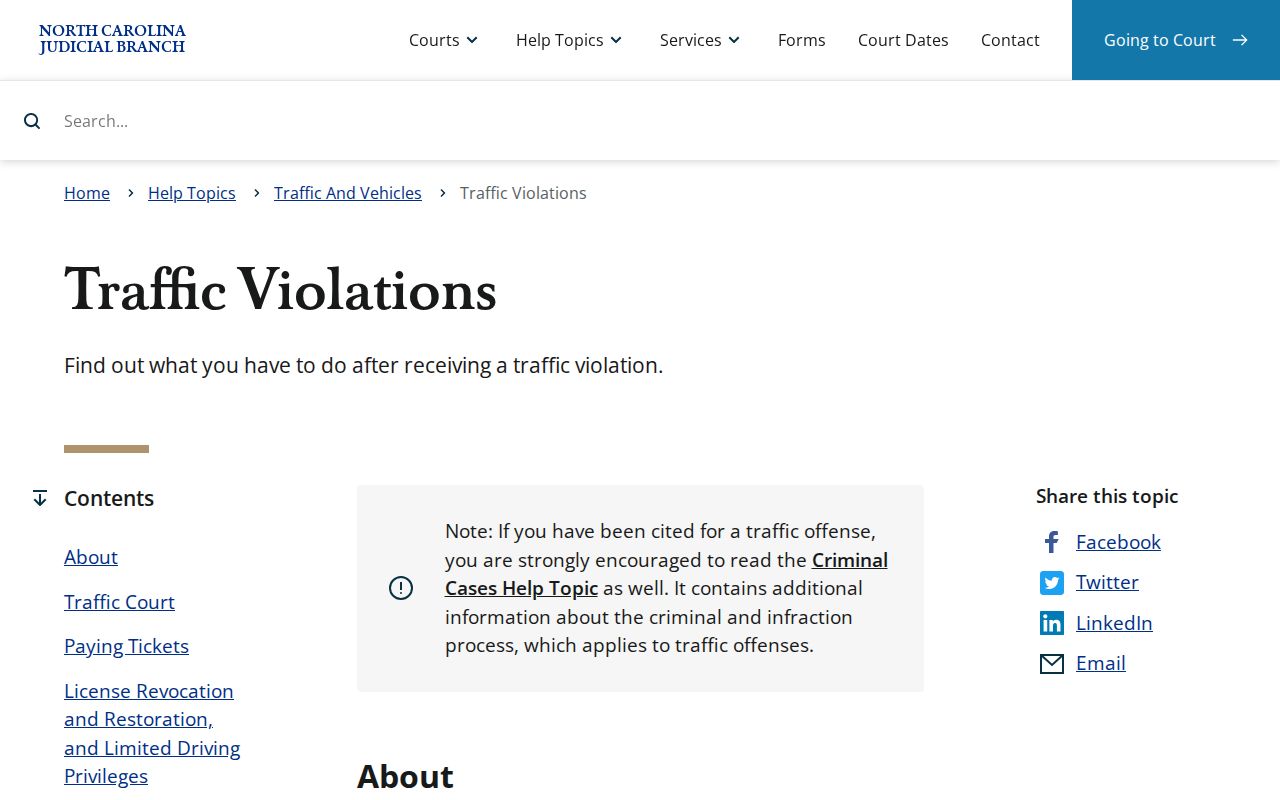
The official traffic material pairs well with the Richmond Portal search. It lays out the court response choices attached to a citation.
Richmond County Portal Citation Search
Portal search and Portal payment are related but separate steps. Smart Search gives you the Case Summary and citation-number filtering. Make Payments lists outstanding eligible balances and can issue a receipt by print or email after processing. The guide notes that required payment criteria vary by payment type and are marked on the live screen. If the payment path fails, the official fallback is to try Edge or Chrome, another Windows device, or the clerk. Review the citation case itself before paying anything.
Portal access does not replace a clerk confirmation for an uncertain balance, a paper-era file, a restricted document, or a formal copy. It also does not make every case payable online. The court record remains the reliable place to confirm which case you are addressing and whether an upcoming setting is still on the docket.
Traffic Court Dates in Richmond County
Every traffic citation carries a court date. Use the ticket as your first reference. Then confirm a pending date through Smart Search's hearing information, Portal Search Hearings, or the Richmond criminal calendar. Search Hearings scans current court calendars by location, hearing type, identifier, and date range. A calendar can help show a setting. But a live Case Summary and the clerk beat it when the date is near, has changed, or was hit by a closure.
| Citation or record number | Use the number printed on the citation, or the court record number when known. A Richmond case number may end -760. |
|---|---|
| Location | Select Richmond in Search Hearings to focus on the local court setting. |
| Hearing type | Choose the relevant hearing type before supplying the precise search criteria. |
| Date range | Portal requires a bounded date search; use the citation date as a starting point. |
| Status and event | Read the Case Summary for a pending, disposed, rescheduled, or called-and-failed entry. |
Richmond County Traffic Date Fallback
When the online date looks off, open the official Richmond criminal calendar. Then call the clerk. The Clerk of Superior Court is at (910) 419-7400. Search Hearings works best for current location and time, and the calendar serves as a second channel. The clerk is the local source when a date was missed. The clerk is also the source when a closure forces rescheduling. That sequence keeps your check tied to Richmond's real court channels instead of an unverified schedule.
A traffic date can be a hearing, an appearance, or another scheduled event. It is not always the final trial date. Read the hearing label and the live case status together. If Portal shows converted older events at 12:00 a.m., that timestamp reflects the eCourts conversion convention. It is not a midnight setting.
Note: Confirmation matters most close to court. A calendar entry can change through a continuance, reset, closure, or clerk instruction.
Paying a Ticket vs Fighting It
Paying a waivable Richmond traffic ticket is a plea. NCAOC treats payment as guilty or responsible as charged. It also waives the court appearance. Choose not to waive. You may appear in court instead. Some citations qualify for online reduction or dismissal through the District Attorney's Citation Services. The citation and the live Portal record control the actual case response. Richmond County posts no fixed fine schedule and no local deferred-disposition fee. Never assume a dollar amount from a general description of the offense.
| Paying an eligible ticket | Appearing to address the ticket |
|---|---|
| May waive the appearance for a waivable matter. | Retains the court appearance path for a matter that is not waived. |
| Use Make Payments only if the live Portal identifies an eligible balance. | Use the citation and current hearing information to confirm the court date. |
| Richmond accepts eligible online card payments with processing fees. | The court file records the hearing, plea or disposition, and court activity. |
| Do not infer a fixed county fine from the Portal or a general fee chart. | Do not treat a calendar listing as final without checking the current case record. |
Missed Richmond traffic date: NCAOC describes a missed date as “called and failed.” After 20 days an FTA may issue. The clerk is the first local contact for the case and, in some situations, a judge may strike the FTA and set a new date.
Richmond County Traffic Payment Channels
Eligible Richmond County court matters can be paid several ways. By mail, use a money order or certified check. Make it payable to the Richmond County Clerk of Superior Court. Include the citation number. The Cashier's Office at 105 W. Franklin St. takes cash and card with processing fees. It also accepts money order and certified check. No listed channel accepts personal checks. Online eligible payments use cards with processing fees. A payment page is not a records-order form. Call before assuming any method works for a copy request. The official Richmond County payment information page spells out each local channel in full.
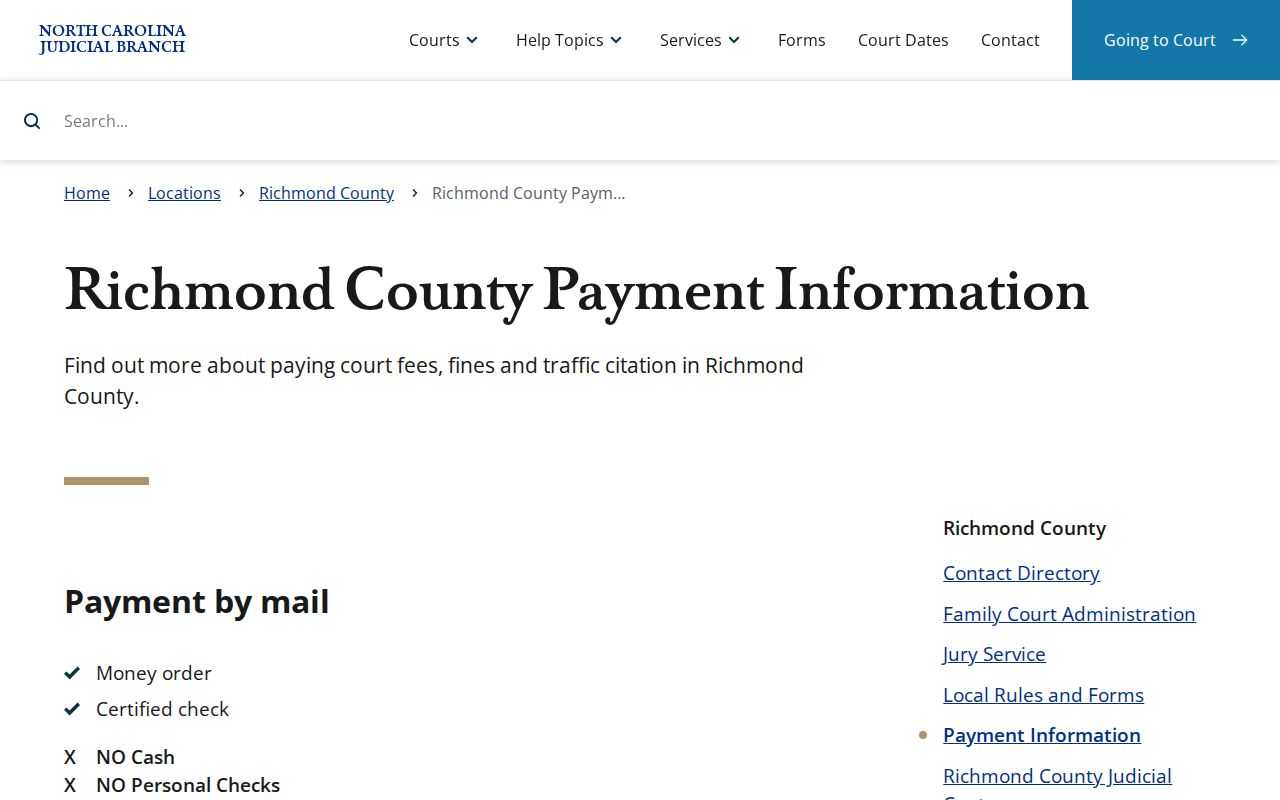
When a live case shows an eligible court obligation but the online route stalls, the county payment source is the practical fallback. Call the clerk first.
Two Records: Court File and Driver File
Two files sit behind every Richmond traffic matter. The court file lives with the Richmond Clerk and Portal. It shows the charge, the setting, the plea or disposition, and the court's financial activity. The driver record belongs to NCDMV. That file reflects convictions and administrative licensing consequences reported to the state. When a case ends in conviction or a finding of responsibility, the court system reports it to NCDMV. Keep the two straight. Don't expect the court file to answer every DMV question.
| Record | Court traffic case file | NCDMV driver file |
|---|---|---|
| Custodian | Richmond County Clerk of Superior Court and Portal. | North Carolina Division of Motor Vehicles. |
| Focus | Citation charge, court date, case events, plea or disposition, and court financial activity. | Convictions and administrative licensing consequences reported by the court. |
| Local court use | Confirm the Richmond case and hearing through Portal or the clerk. | Separate state-held record; it does not replace the court case file. |
Richmond County Traffic FTA Status
Miss your court date and an FTA can issue after 20 days. The money follows fast. The January 2026 criminal-cost chart spells out the pieces. A $200 failure-to-appear fee is charged once per case. There is also a $50 failure-to-comply fee, plus a $20 fee for paying by installments. Those figures are statutory add-ons, not the whole cost of the traffic citation. A judge may order an amount. The court can report it if it goes unpaid 40 days. Richmond County drivers checking the posture of a case start with the docket itself. The clerk is the other stop.
NCDMV’s failure-to-appear and failure-to-pay information lays out what happens to a license once that report goes through.
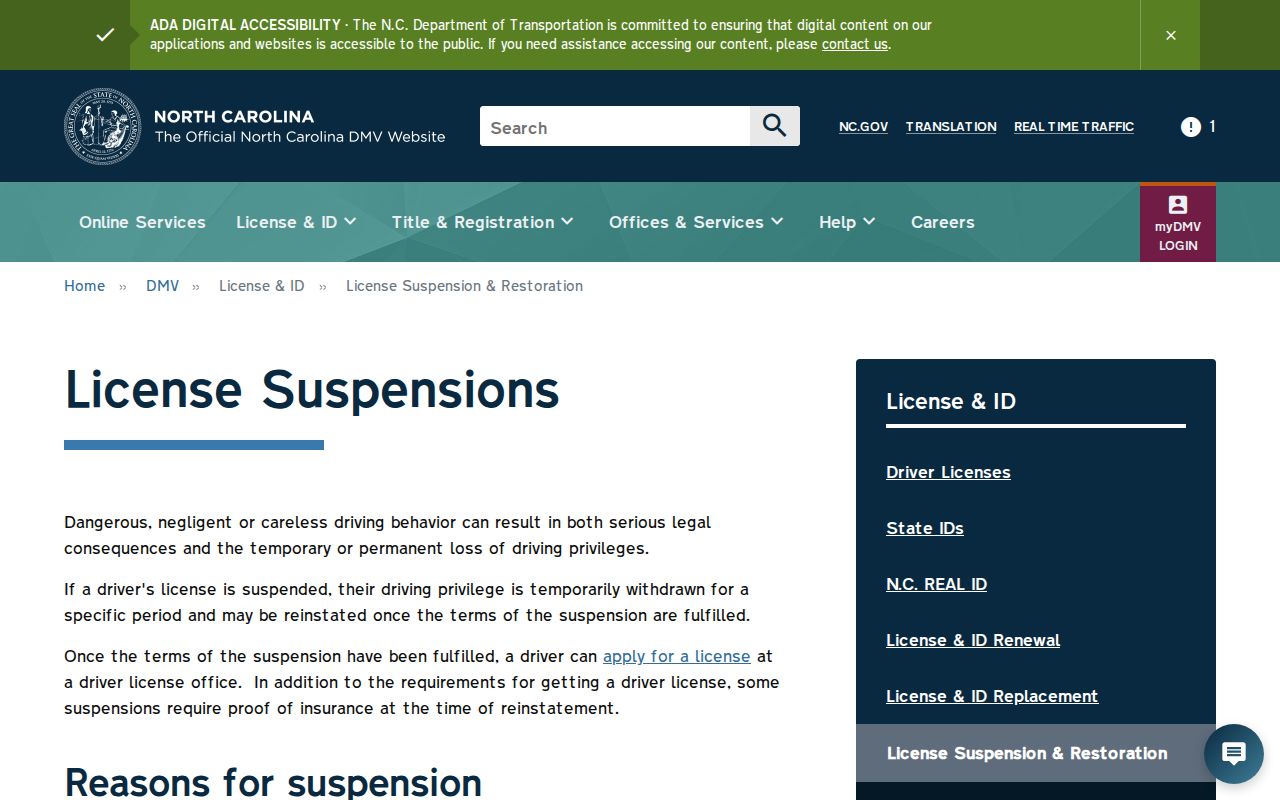
That state page is not the case file. For Richmond court status, check the Portal or the clerk first.
Traffic Record Copy Fees
A traffic court copy is a clerk-held case-file request, not a fixed citation fine. Richmond posts no separate local traffic-copy chart. Statewide components for document preparation and certification come from NCAOC's January 2026 Miscellaneous Costs Chart. Confirm the document and the total with the clerk. That step comes before ordering. NCAOC permits Portal document-viewing or printing fees. The court lists no current public amount for a document image.
| Traffic case-file item | Fee component | Request note |
|---|---|---|
| First page of a document | $2.00 | Statewide preparation charge for each document’s first page. |
| Additional page of the same document | $0.25 | Applies after the first page. |
| Certificate under seal | $3.00 | Added when a certified copy requires it. |
| Exemplification | $10.00 | A distinct service; ask the clerk whether it is needed. |
| County criminal-record search | $25.00 | Listed statewide and not a universal traffic-copy fee. |
Richmond County Traffic Compliance Check
Under G.S. 20-24.1, NCDMV treats failure-to-appear and failure-to-pay suspensions as indefinite until the court case is complied with. Even then, NCDMV restoration requirements still apply. So the sequence has two steps. First, resolve the Richmond court case. Second, meet any separate NCDMV requirement. Compliance does not turn the NCDMV file into a court record or make the clerk its custodian, and NCDMV's restoration information maps the state's post-compliance route.
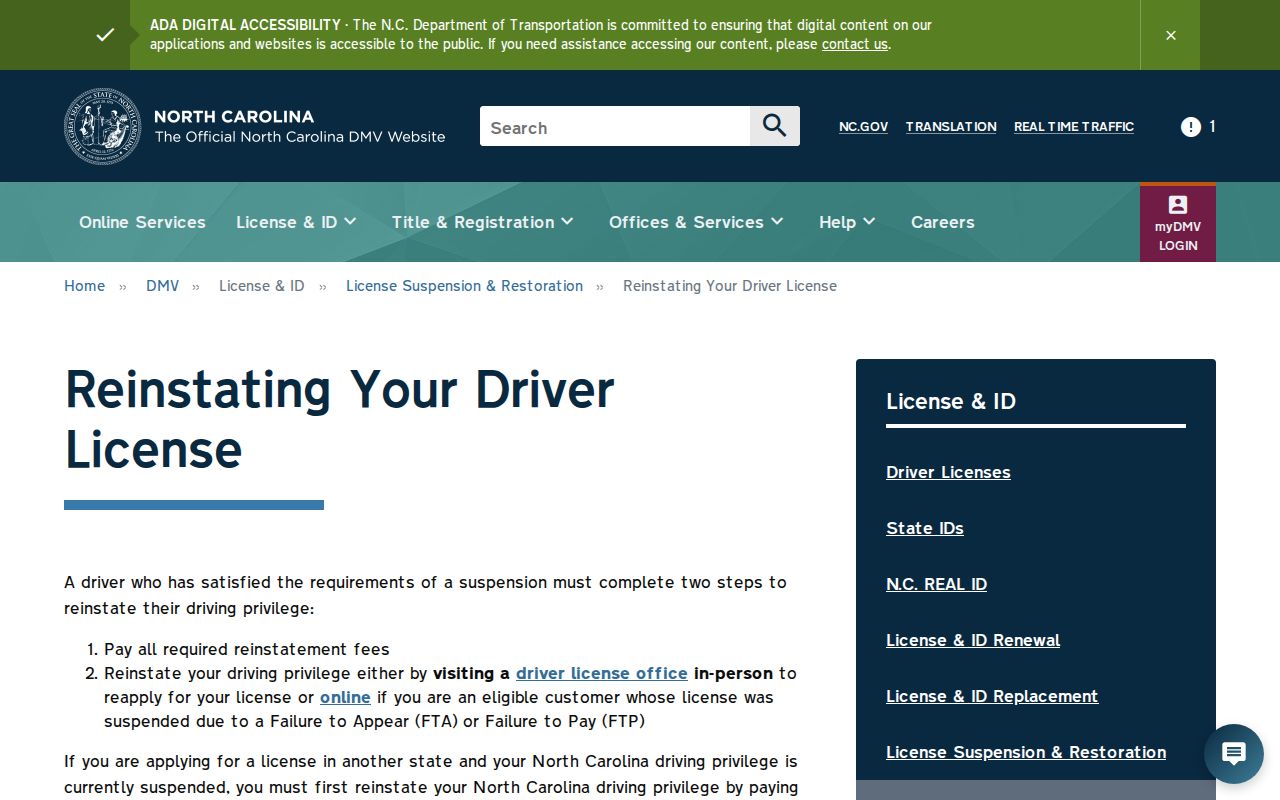
That state route runs separately from the Richmond case file. For the local traffic court case itself, the Clerk and Portal remain the sources.